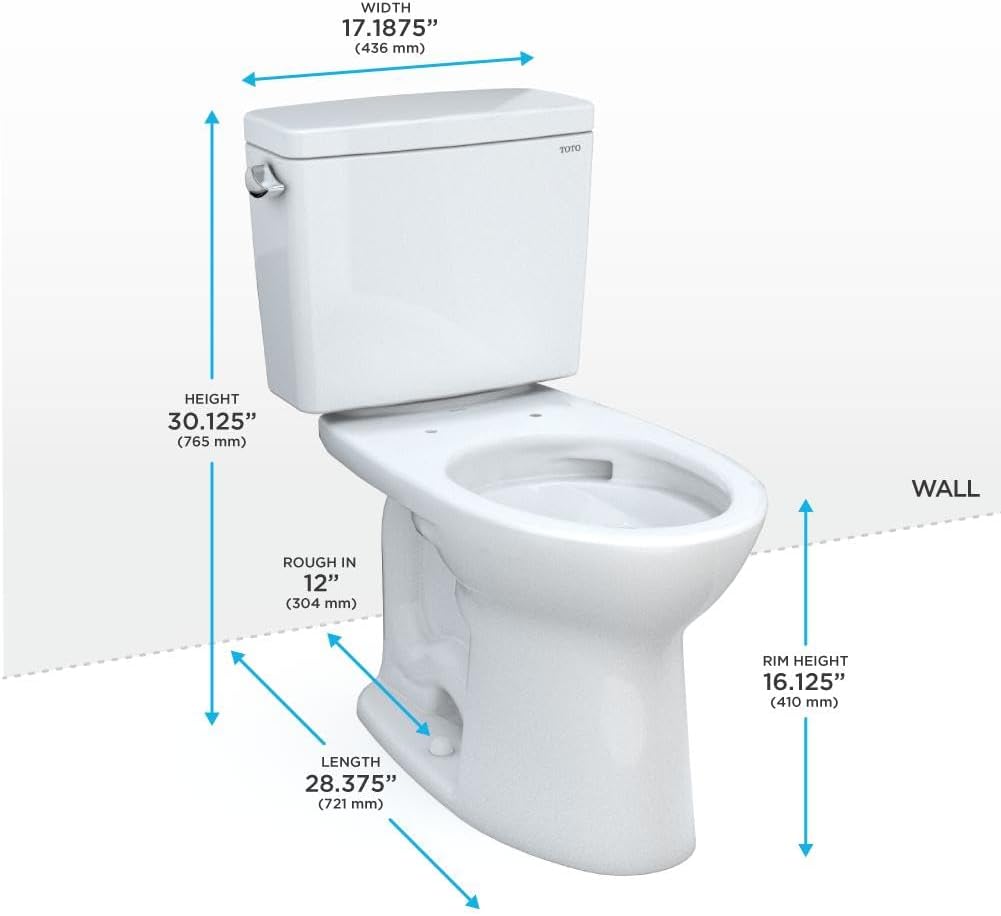
You measured the floor space, picked a finish that works with your tile, and found a toilet that looks exactly right in the render. Then the box arrives. You slide it out, line it up over the flange — the metal collar set into the floor that the toilet bolts down to — and realize the base overhangs the wall by three inches because the rough-in (the distance from the wall behind the toilet to the center of that flange) is 10 inches in your bathroom, not the standard 12 inches the toilet was built for. That’s a 70-pound return on a fragile porcelain fixture, a restocking fee, and a delayed install. It happens more often than any retailer will tell you. This guide is the spec checklist you run before you order — covering rough-in distance, seat height, flush mechanism, and the ADA compliance rules that matter whether you’re renovating a private master bath or outfitting a commercial washroom.
Step 1: Nail the Rough-In Before Anything Else
The rough-in measurement is the single most disqualifying spec in toilet selection. Get it wrong and nothing else matters.
How to measure it: With the old toilet still in place, measure from the finished wall (not the baseboard) to the center of the floor bolts — the two bolts capped under plastic covers at the base of the toilet. If there are four bolts, measure to the rear set. That number, almost always 10, 12, or 14 inches, is your rough-in.
As This Old House’s rough-in guide explains, 12-inch rough-ins cover roughly 80–85% of residential installations built after the 1950s. Ten-inch rough-ins appear most often in older homes and tight powder rooms. Fourteen-inch rough-ins show up in some older construction and certain manufactured housing. Bob Vila’s rough-in overview confirms that ordering a 12-inch toilet into a 10-inch rough-in space is the leading cause of toilet return shipments.
The small-bathroom workaround: If you have a 10-inch rough-in but want a broader selection, manufacturers including Kohler (the Cimarron series), American Standard, and TOTO offer 10-inch rough-in variants of their most popular models — but you must filter explicitly for them. The product listing will note it; the hero photo will not look different.
Wall-hung toilets change the math entirely: Wall-hung (wall-mounted) toilets move the rough-in question to the in-wall carrier frame, not the floor. The drain exits the wall rather than the floor, and the carrier frame itself sets the finished bowl height. This is a full rough-in replacement, not a drop-in swap, and it requires a wall with sufficient depth — typically a minimum 4-inch framing cavity (a 2×6 framed wall or a purpose-built chase). If you are replacing a floor-mount toilet with a wall-hung unit as a renovation upgrade, budget for structural and rough-in work accordingly.
Step 2: Seat Height — “Standard,” “Comfort Height,” and What ADA Actually Requires
This is where vocabulary causes the most confusion in reviews and product listings.
Standard height means the rim sits roughly 14–15 inches off the finished floor. Add a seat (typically 1–1.5 inches) and you’re at 15–16.5 inches to the seating surface. This is the traditional dimension, and it works well for children and shorter adults.
Comfort height (also called “chair height” or, in TOTO’s branding, “Universal Height”) puts the rim at 16–18 inches, yielding a seated height of 17–19 inches with a seat. Most adults — especially anyone over 5’4” or with knee or hip mobility concerns — find this noticeably easier to sit down from and stand up from.
ADA-compliant height per the Americans with Disabilities Act Standards for Accessible Design (Section 604, available at ada.gov) specifies a seated height of 17–19 inches measured to the top of the toilet seat, not the rim. That means the toilet body rim generally needs to land at 16–17.5 inches to hit the ADA window once a seat is installed. Most “comfort height” toilets land in ADA territory, but you must confirm: the ADA standard is on the seated surface, not the rough porcelain rim.
The IRC (2021 edition, Chapter 27) does not mandate toilet seat height in residential construction — that’s an ADA/FHA requirement triggered in commercial occupancies and accessible dwelling units. But as Houzz’s ADA bathroom design guide notes, specifying comfort height universally in a private master bath costs nothing extra and is a meaningful accessibility upgrade that supports aging-in-place design.
By the numbers:
| Height designation | Rim height (approx.) | Seated height w/ seat | ADA-compliant? |
|---|---|---|---|
| Standard | 14–15 in | 15–16.5 in | No |
| Comfort / Chair Height | 16–18 in | 17–19 in | Typically yes |
| ADA-specific spec | 16–17.5 in rim | 17–19 in | Yes (verify seat) |
One tradeoff worth naming directly: comfort-height toilets are not ideal for households where children under 8 are the primary users. The seated height puts their feet off the floor, which matters for posture and comfort. A household with mixed users often solves this with a comfort-height toilet and a removable step stool — not a glamorous solution, but an honest one.
Step 3: Single Flush vs. Dual Flush — When the Water Math Actually Pencils
Dual-flush toilets offer two flush volumes: a reduced-volume flush (typically 0.8–1.0 gallons per flush, or GPF) for liquid waste and a full flush (1.28–1.6 GPF) for solid waste. The EPA’s WaterSense program, cited in Consumer Reports’ toilet buying guide, certifies toilets at 1.28 GPF or less as high-efficiency — that’s the threshold to chase, not the older federal maximum of 1.6 GPF.
When dual flush is worth the premium:
- Commercial applications (office buildings, schools, healthcare) where flush count is high and water costs are metered — the payback period on a WaterSense dual-flush fixture shortens quickly.
- Jurisdictions with tiered water pricing or drought restrictions (California, Colorado, parts of the Southwest) where rebate programs may offset first cost.
- New construction where the rough-in is being set fresh and there’s no retrofit penalty.
When it’s less compelling:
- Retrofit into an older building with low water pressure. Dual-flush designs that depend on gravity feed (most residential units) require adequate head pressure for the full flush to clear reliably. Owners in buildings with chronic low-pressure reports have flagged incomplete flush performance in aggregated reviews across multiple platforms.
- Households with septic systems on a tight leach-field budget sometimes benefit from lower flush frequency rather than volume reduction — worth a conversation with your septic contractor.
- Price gap consideration: as of mid-2026, the market spread between a quality single-flush 1.28 GPF WaterSense toilet (Kohler Highline, American Standard Champion, TOTO Drake) and a comparable dual-flush model runs roughly $80–$200 at retail. In residential use averaging 5 flushes per person per day, the water savings from dual flush versus a single 1.28 GPF flush rarely justify that gap on a pure payback basis alone — the value is partially environmental, partially rebate-driven.
Pressure-assist vs. gravity flush is a related but distinct decision. Pressure-assist toilets use compressed air to augment the flush — they’re noticeably louder but move waste more reliably, making them the preferred spec for commercial restrooms and high-traffic hospitality installations. Gravity-flush dominates residential for its quieter operation. If you’re speccing commercial applications or a basement bathroom with a long drain run and modest pitch, pressure-assist deserves a line on your checklist.
Step 4: The Full Pre-Order Checklist
Here’s the decision framework consolidated into a working checklist for any toilet purchase. Run it before you finalize a spec, whether you’re sourcing a single powder-room unit or writing a procurement spec for a 40-stall commercial build.
Dimensional clearances (IRC minimums, residential):
- 15 inches minimum from centerline of toilet to any side wall or obstruction (IRC 2021). ADA raises this to 18 inches on the accessible side for commercial/accessible units.
- 21 inches minimum clear floor space in front of the toilet (IRC residential). ADA requires 60 inches wide × 56 inches deep minimum clear floor space for a wall-hung toilet, 60 × 59 inches for floor-mount.
- Rough-in confirmed to within ±1 inch of toilet’s rated rough-in spec.
Height:
- Comfort height (chair height / 17–19 in seated) unless primary user pool is predominantly children or shorter adults.
- ADA-compliant seated height (17–19 in) confirmed for any commercial, hospitality, or accessible dwelling unit.
Flush:
- WaterSense certified (1.28 GPF or below) — this is now the baseline, not a premium feature.
- Dual flush only if rebates apply, water costs are metered at scale, or the environmental case is the primary driver.
- Pressure-assist for commercial high-traffic or long drain runs.
Seat:
- Seat sold separately or included — most toilets above $400 MSRP ship without a seat. Confirm before ordering.
- Seat height contribution (typically 1–1.25 inches): factor this into your ADA seated-height calculation.
- Soft-close hinges: standard on most mid-range and premium seats; confirm if noise is a concern.
Rough-in confirmation:
- Measure from finished wall to bolt centerline — not from drywall edge, not from baseboard.
- If the measurement is ambiguous (between 11 and 12 inches, for example), a 12-inch toilet typically installs with a small gap at the rear that is covered by the tank; a 14-inch toilet in a 12-inch rough-in will not fit. Default conservative: confirm the exact rough-in before speccing.
The Decision Rule
If you take one framework from this checklist, make it this:
Rough-in is a disqualifier. Height is a preference. Flush volume is a policy.
Confirm your rough-in before you look at a single product photo — it eliminates 60–70% of the market from consideration immediately and prevents the return. Then choose comfort height unless there’s a specific user case against it; the ADA range (17–19 in seated) is simply better ergonomics for most adults. Finally, default to a WaterSense-certified 1.28 GPF single-flush model unless you’re in a commercial application with metered water costs or a jurisdiction with active rebate programs, in which case dual flush earns its price premium.
Get those three decisions right in that order, and the rest of toilet selection — trapway size, rim design (rimless vs. concealed), elongated vs. round bowl — becomes a comfort and aesthetic conversation, not a costly spec error waiting to happen.