You measured every inch of that bathroom, picked the tub, placed the order — and then your contractor called to say the floor joists can’t handle the weight. Or the drain finish arrived in “brushed gold” that photographs identically to your faucet but clashes under the vanity lighting you already spec’d. These are the two gut-punch moments that define freestanding tub projects gone sideways, and they both trace back to the same gap: the spec sheet tells you dimensions and gallons, but it doesn’t tell you how to make the whole system work together.
This guide is for the renovator or designer who’s past the “what even is a freestanding tub?” stage. You know the product category; you may have one on a purchase order or under active consideration. What follows is a decision framework covering the two materials that dominate the current market — acrylic and stone resin — with honest math on subfloor load, a plain-language breakdown of drain finish matching, and the spec-sheet gaps manufacturers consistently leave out.
| EDITOR'S PICK65'' Freestanding Stone Resin B… | Mid-tierWOODBRIDGE 67" Acrylic Freestan… | Budget pickWOODBRIDGE 59" Acrylic Freestan… | |
|---|---|---|---|
| Material | Stone Resin | Acrylic | Acrylic |
| Length | 65" | 67" | 59" |
| Drain Finish | — | Brushed Gold | Matte Black |
| Pop-up Drain | ✓ | — | — |
| Overflow Included | — | ✓ | ✓ |
| Price | $1,538.00 | $758.00 | $611.13 |
| See on Amazon → | See on Amazon → | See on Amazon → |
Material Fundamentals: What You’re Actually Buying
Acrylic
Acrylic tubs are formed by heating and vacuum-molding a sheet of PMMA (polymethyl methacrylate) plastic over a mold, then reinforcing the underside with fiberglass and, on better units, a wooden or steel subframe. The material is warm to the touch, repairable (surface scratches can be polished out), and light. Published spec sheets for a standard 67-inch acrylic freestanding — from brands including Kohler’s freestanding catalog and DXV’s freestanding line, per each brand’s 2025 product specification documentation — typically list dry weights between 55 and 90 lbs. Fill that tub with 50–60 gallons of water (roughly 417–500 lbs, calculated at 8.34 lbs per US gallon) and add an average adult (approximately 175 lbs), and you’re delivering roughly 650–765 lbs to the floor at point of load.
The trade-off: acrylic flexes. This Old House has covered the structural and material behavior of acrylic tub construction in its bathroom renovation guidance, noting that thinner-gauge units can produce a perceptible flex underfoot — a subtle movement when shifting weight that buyers find unsatisfying at the $2,000–$5,000 price tier. Surface hardness is lower than stone resin; sharp impacts can chip or crack the surface, though repair kits do exist.
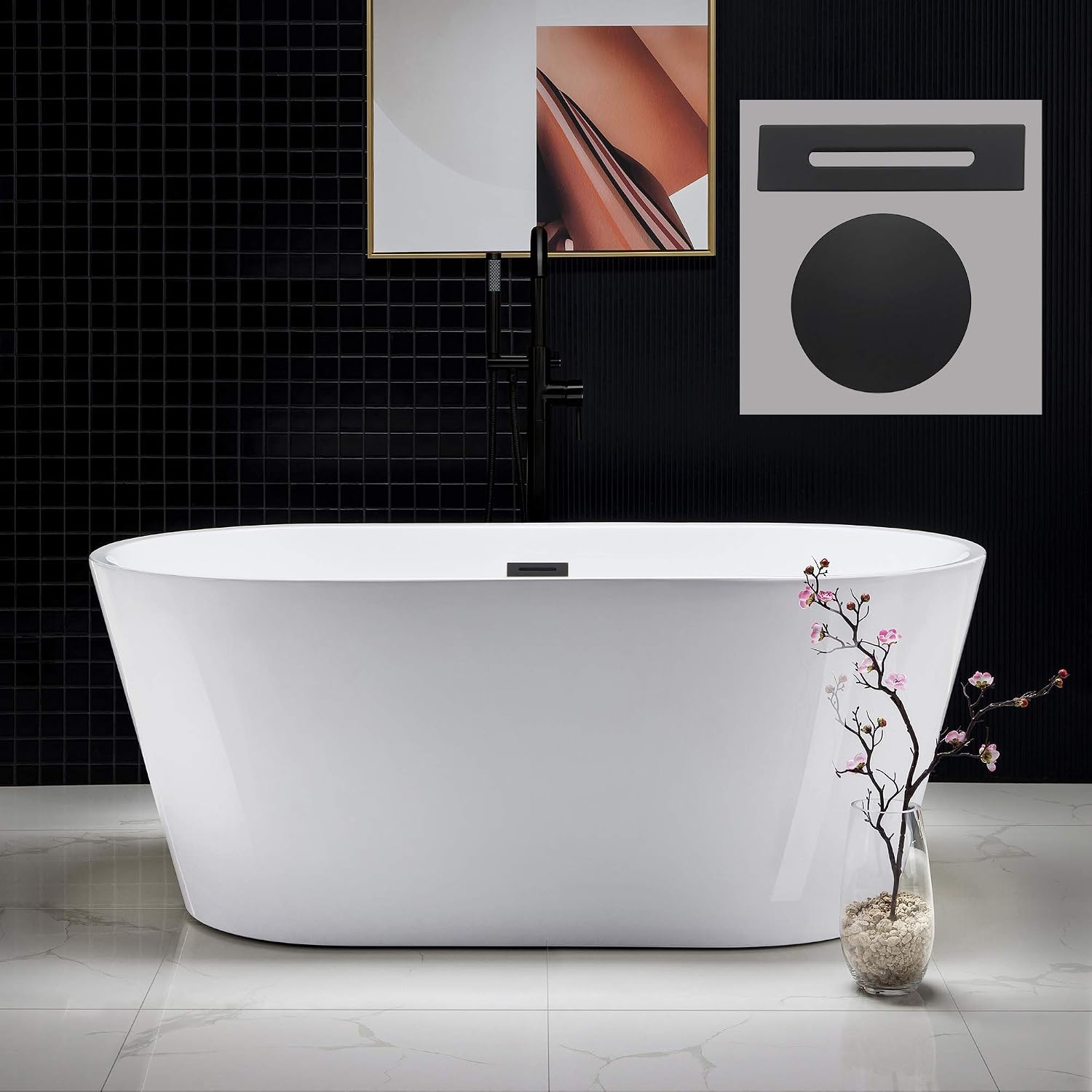
WOODBRIDGE
$611.13
In stock on Amazon
Check price on AmazonStone Resin
Stone resin composites — sold under proprietary names including Victoria + Albert’s QUARRYCAST, as well as StoneTec and Cristalplant — are cast as solid shells, typically 8–12mm thick throughout. Per Victoria + Albert’s published material technical data on QUARRYCAST composition, the material retains heat measurably longer than standard acrylic, which matters for long soaks. The surface is non-porous, harder, and matte by default (most composites are gel-coat finished in white or off-white). Published dry weights for a similar 67-inch stone resin freestanding run 260 to 440 lbs — three to five times an equivalent acrylic unit.
Fill the same tub with water and a bather, and you’re now delivering 850–1,100+ lbs to a relatively small footprint (most freestandings contact the floor through four feet or a continuous base ring across roughly 4–8 square feet).
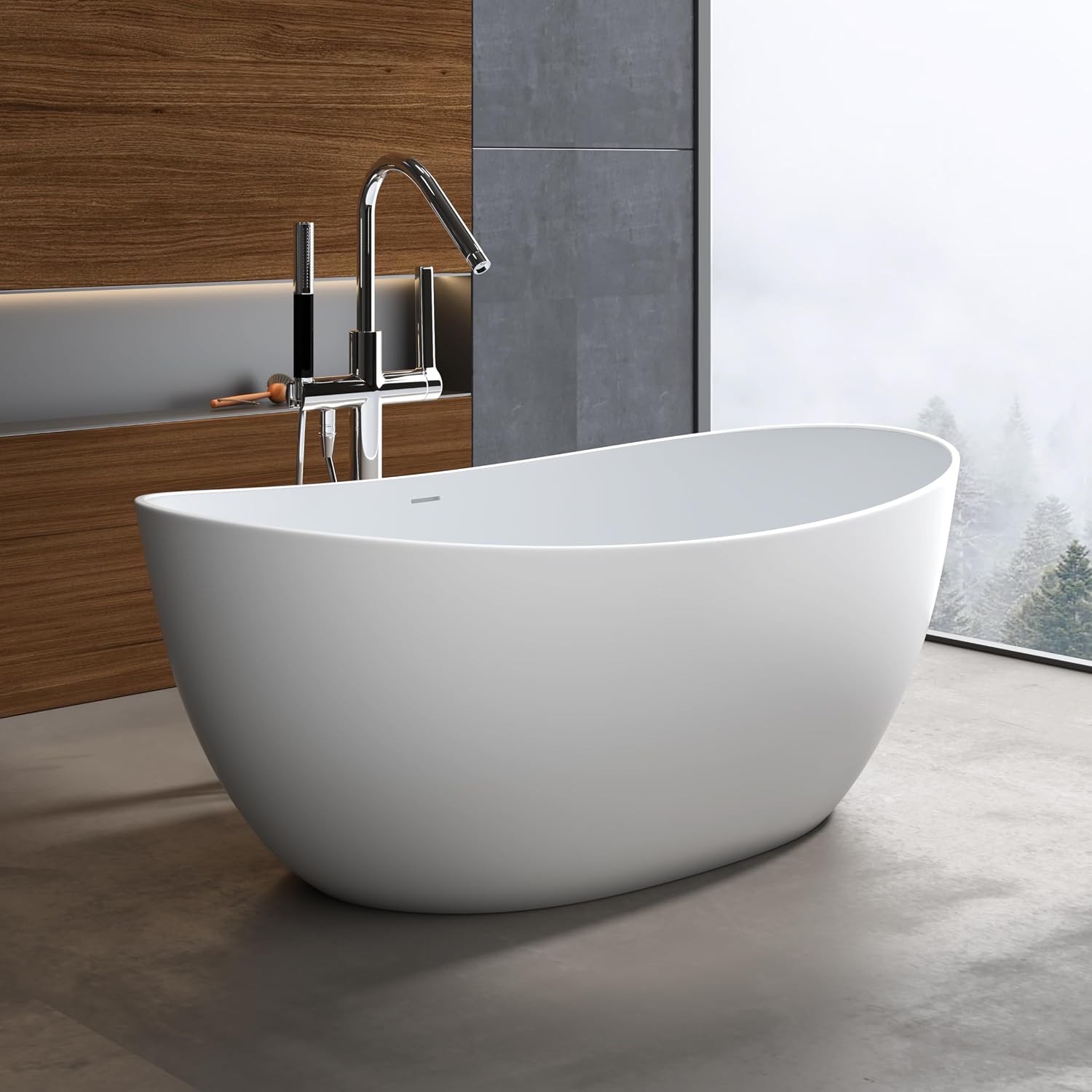
65''
$1,538.00
In stock on Amazon
Check price on AmazonHow the Materials Compare at a Glance
| Attribute | Acrylic | Stone Resin |
|---|---|---|
| Typical dry weight (67”) | 55–90 lbs | 260–440 lbs |
| Total filled load (approx.) | 650–765 lbs | 850–1,100+ lbs |
| Surface repairability | Yes, polishable | Limited; harder surface |
| Thermal retention | Standard | Superior (per V+A material data) |
| Entry price range | $800–$2,500 | $2,500–$8,000+ |
| Slab floor: structurally uncomplicated? | Yes | Yes |
| Wood-frame floor: structural review needed? | Rarely | Almost always |
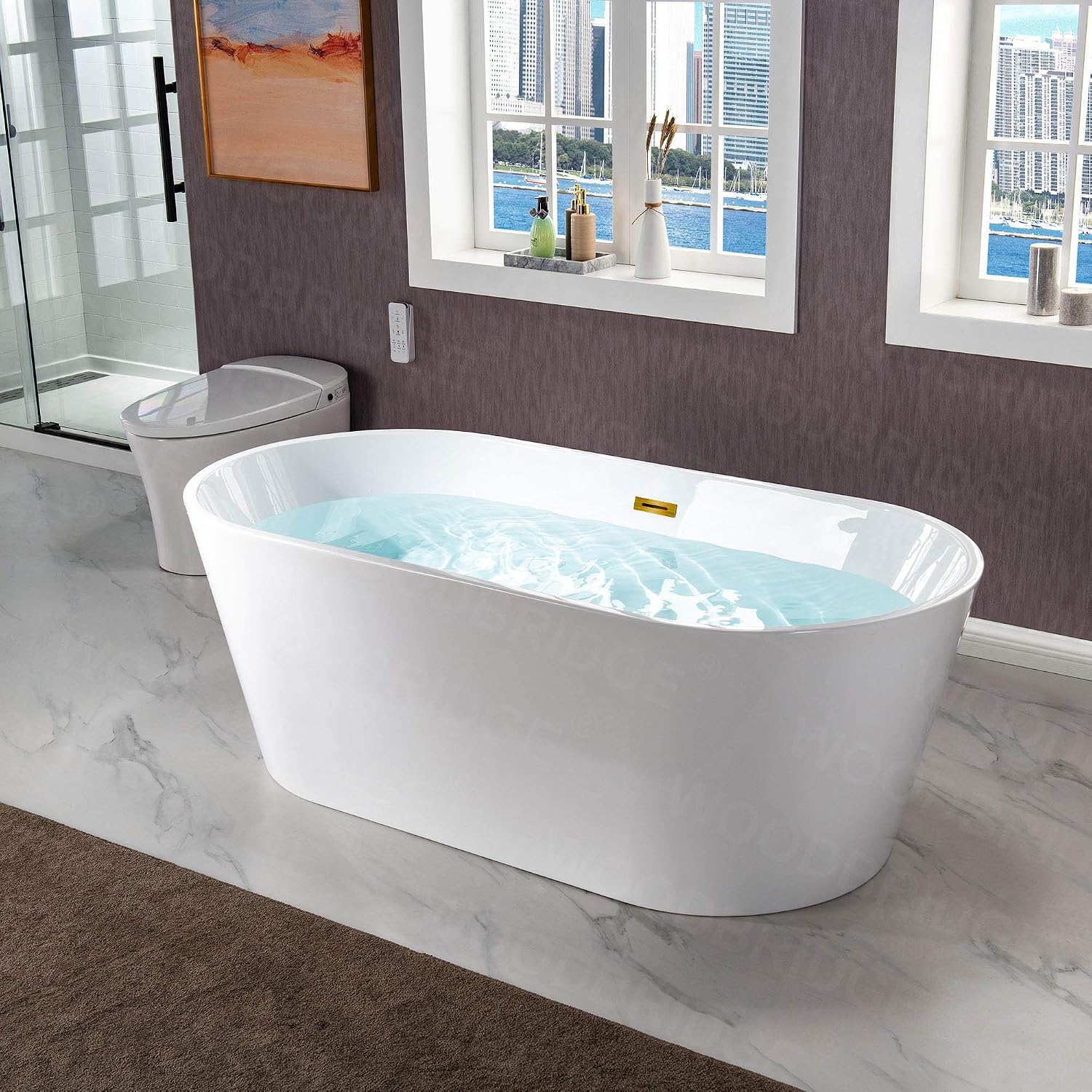
WOODBRIDGE
$758.00
In stock on Amazon
Check price on AmazonSubfloor Load: The Calculation Your Contractor May Skip
The International Residential Code 2021, Chapter 3, specifies a standard residential floor live load of 40 pounds per square foot (psf) for habitable spaces including bathrooms. But that’s a distributed load figure — it assumes weight spread across the whole room. A freestanding tub concentrates its load through a very small contact area, which is a point-load problem, not a uniform-load problem. This Old House, in its structural coverage of residential floor load capacity, makes this distinction clearly: a concentrated load near mid-span of a joist run is far more consequential than the same weight spread wall-to-wall.
By the numbers — point load comparison:
| Configuration | Dry Weight | Water + Bather | Total Point Load (approx.) |
|---|---|---|---|
| 67” acrylic freestanding | 75 lbs | 650 lbs | ~725 lbs |
| 67” stone resin freestanding | 350 lbs | 650 lbs | ~1,000 lbs |
| Filled cast iron clawfoot (comparable size) | 300 lbs | 650 lbs | ~950 lbs |
A standard 2x10 floor joist at 16 inches on center, spanning 12 feet, is typically rated for roughly 50–60 psf of distributed load — but a 1,000-lb point load delivered to mid-span can exceed that joist’s safe bending capacity depending on lumber grade and span. Per the IRC 2021, any concentrated load exceeding what the existing framing was designed for requires either a structural assessment or reinforcement (sistered joists, blocking, or a dedicated pedestal pad). This is the single most common piece of information missing from stone resin tub spec sheets.
Practical decision rule: If your project is on a concrete slab first floor, stone resin is structurally uncontroversial. If it’s on a wood-frame floor — especially a second-floor master bath, which is the aspirational placement for most luxury freestanding installs — budget $300–$800 for a structural carpenter to assess and, if needed, reinforce the joist bay before the tub arrives. Do this before the tile goes down. Doing it after is a $2,000–$4,000 mistake.
Bob Vila’s bathroom renovation coverage similarly flags subfloor reinforcement as a prerequisite step that is frequently skipped by homeowners who focus on the fixture selection and defer the structural question until rough-in — at which point the tile schedule has already been set.
Drain Finish Matching: Where the Spec Sheet Goes Silent
A freestanding tub’s drain assembly is usually sold separately, specified separately, and sourced from a completely different supply chain than the tub itself. This creates the finish-matching problem that the Houzz 2024 U.S. Bathroom Trends Study identifies as one of the top sources of mid-project specification regret: the drain finish “matches” in name but not in reality.
Why “Brushed Gold” ≠ “Brushed Gold”
Finish names are not standardized across manufacturers. What one brand calls “Luxe Gold,” another calls “Vibrant Brushed Moderne Brass,” and a generic tub drain manufacturer calls “Brushed Gold” are physically different PVD (Physical Vapor Deposition) coatings applied to different base metals — brass, zinc alloy, or stainless — at different thicknesses and with different surface preparation. Under natural light they may photograph identically. Under the warm downlights typical of a bathroom install, the undertones diverge: one reads warm yellow-gold, another reads champagne, a third reads almost bronze.
Architectural Digest has covered this cross-brand finish incompatibility issue in its bathroom design roundups, noting that the mismatch typically becomes visible only after installation, when return or replacement is expensive. Dezeen’s bathroom design coverage similarly highlights matte black as the finish family with the most consistent cross-brand compatibility, because surface texture variation between manufacturers is less perceptible in flat black than in metallic or polished finishes.
Practical rules for drain finish matching:
-
Specify drain brand before specifying tub. The drain dictates the finish ecosystem. Source a drain from a single premium brand’s freestanding drain collection, then select a tub that fits that drain’s rough-in — not the reverse.
-
Order physical finish samples before purchase. Most premium fixture distributors will pull finish samples on request. Hold them next to your faucet and showerhead trim in the actual room lighting. A photo comparison on a phone is not sufficient.
-
Matte black is the most forgiving finish family. If a client is committed to brushed brass or unlacquered brass, treat every component as a separate finish-matching problem and request physical samples for each individual piece.
The Drain Rough-In Dimension Most Specs Omit
Standard US freestanding tub drains use a 1½-inch or 2-inch drain opening, but the critical spec is the drain center offset from the tub’s centerline — which determines whether your existing drain rough-in (the pipe stubbed up from the subfloor) will align. Most spec sheets list the drain location in relation to the tub’s length (for example, “drain center 6 inches from foot end”), but they do not specify the tolerance for lateral offset before subfloor work is required. That tolerance is typically ±1 inch before you need to move the drain stack.
If you’re replacing an existing built-in tub with a freestanding and keeping the original drain location, measure the existing drain center and map it against your prospective tub’s drain spec before committing. A two-inch mismatch in drain centerline position costs roughly $150 in rough-in adjustment caught on the front end; it costs $800–$1,500 if the tile is already installed.
The Spec-Sheet Gaps: A Practitioner Checklist
Here’s what the published spec sheet typically covers: outer dimensions, dry weight, capacity in gallons, drain size, and finish options. Here’s what it consistently omits:
- Filled weight at maximum capacity — calculate it yourself: 1 US gallon = 8.34 lbs; multiply by tub capacity and add bather weight
- Floor contact geometry — how many feet, what diameter, what contact area; this drives the structural assessment
- Drain rough-in lateral tolerance — how far off-center the existing stub-out can be before subfloor modification is required
- Finish batch variation policy — whether the manufacturer guarantees finish consistency across a reorder if a component is damaged post-install
- Thermal retention — relevant for stone resin comparison; rarely published as a measurable figure, more often implied by material description
- Warranty terms for surface repair — acrylic and stone resin carry meaningfully different warranty structures for surface damage versus structural failure
For premium residential projects, request these data points directly from the manufacturer’s technical representative before placing the order. Brands including Victoria + Albert, Kaldewei, and Kohler have technical sales support that will answer these questions; their published specification documentation — including Kohler’s 2025 product specification sheets — addresses some but not all of these gaps.
If X, Then Y: The Decision Framework
If the project is on a wood-frame floor above grade → get a structural assessment before specifying stone resin. Budget for potential joist reinforcement per IRC 2021 Chapter 3 requirements. If the client won’t approve that budget, specify acrylic and invest the savings in a higher-grade unit with thicker gauge and a better subframe.
If finish cohesion is the primary design driver → source the drain first from a single premium brand’s freestanding drain collection, then select a tub with a compatible drain rough-in. Do not work in the opposite direction.
If the project is on a concrete slab → stone resin is structurally uncomplicated. The material’s thermal performance and surface durability become the dominant comparison points, and stone resin leads on both against standard acrylic.
If budget is constrained but the look of stone resin is the goal → higher-end acrylic tubs with solid surface gel-coat finishes have closed the visual gap considerably. Surface hardness still trails stone resin composites, but the $1,800–$3,500 price tier delivers a substantially improved feel over entry-level acrylic.
If ADA access is a project requirement → per the Americans with Disabilities Act, 2010 ADA Standards for Accessible Design, Section 607 (bathtubs), accessible bathtub configurations specify seat height and clear floor space requirements that most freestanding tubs do not meet by default. Freestanding tubs in ADA-compliant commercial or accessible residential settings require a separate compliance review. Neither material type has an inherent ADA advantage; the issue is configuration, not material.
The material decision is genuinely secondary to the structural and finish-matching decisions. Get the floor and the drain spec right first. Then choose the material that fits the structural budget and the finish ecosystem you’ve already committed to.