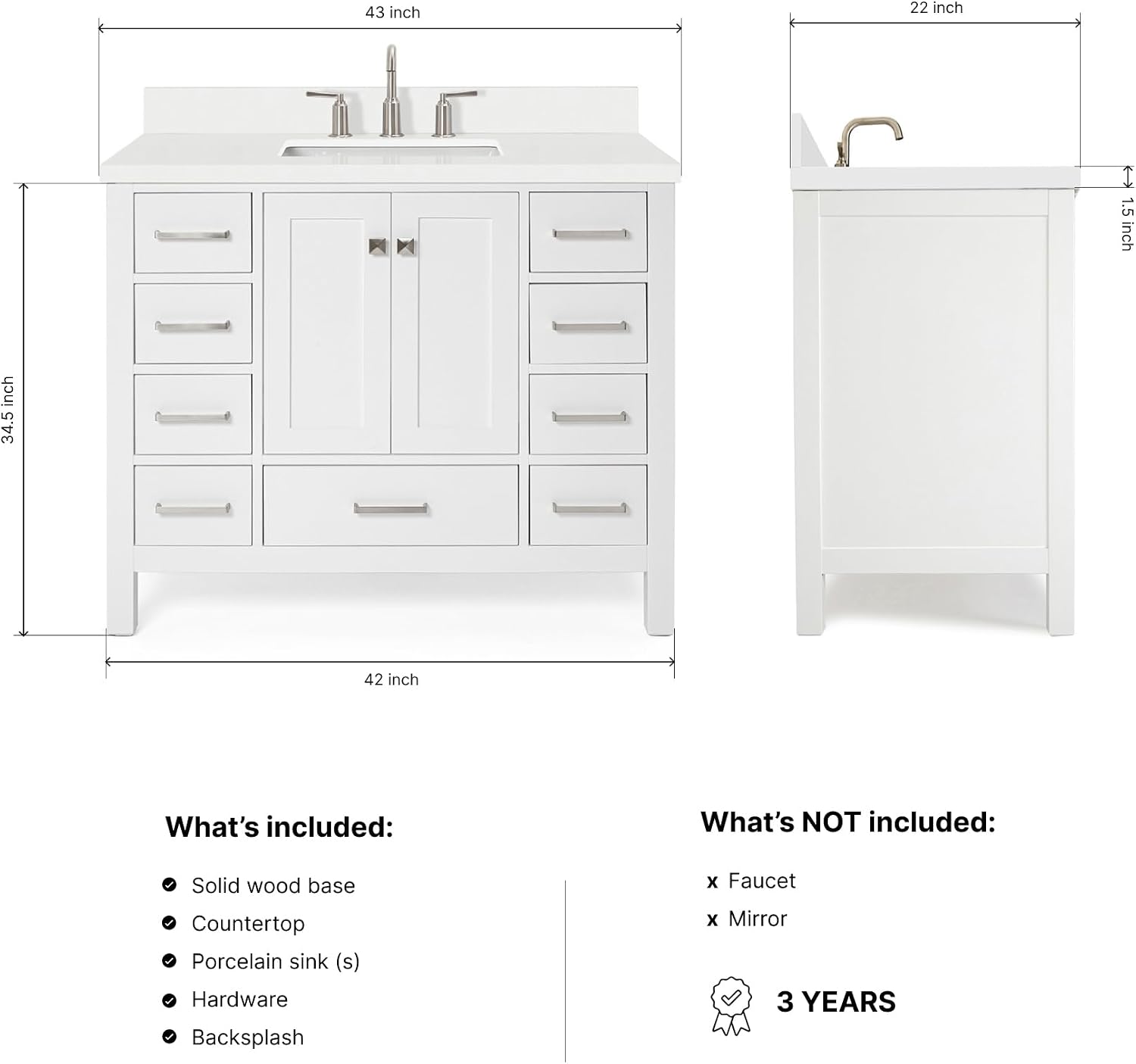
You measured twice and ordered what looked like a beautiful solid-wood vanity — and eighteen months later the door corners are swelling, the finish is clouding near the sink, and you’re wondering where the failure actually started. Spoiler: it started on the spec sheet, before the cabinet ever shipped. A bathroom vanity is three products working as a system — the cabinet (the box and doors that hold everything), the countertop (the flat surface it sits under), and the sink (the basin, either dropped in from above or “undermounted,” meaning bonded beneath the countertop for a seamless look). Each component has its own failure modes, and the way they interact creates a fourth set of problems no individual spec sheet warns you about. This guide breaks down what to look for in each layer — and gives you a decision framework for matching the right material combination to your renovation’s actual risk environment.
What “Solid Wood” Actually Means on a Vanity Spec Sheet — and Why It Matters
Here’s where most buyers get burned: the phrase “solid wood construction” is not a standardized claim. It can mean the face frame (the visible front border of the cabinet) is solid wood while the box sides are particleboard or MDF (medium-density fiberboard, a pressed-wood composite). It can also mean the entire cabinet — box, shelves, doors — is cut from dimensional lumber. Those are wildly different products at wildly different price points, and the failure risk in a high-humidity bathroom environment is not even close.
The industry grades cabinet box construction along a well-understood spectrum. Per reporting in Kitchen & Bath Business and trade documentation from cabinet manufacturers, the hierarchy looks roughly like this:
- Particleboard core with paper or melamine laminate: lowest cost, most moisture-sensitive. Chips and swells at exposed edges.
- MDF core with thermofoil or paint finish: more dimensionally stable than particleboard, but still vulnerable to prolonged moisture intrusion at joints and edges.
- Plywood box (typically 1/2” or 3/4” Baltic birch or cabinet-grade ply): the sweet spot for bathroom applications. Plywood resists moisture cycling far better than particleboard because its cross-laminated grain structure resists swelling.
- Solid-wood box (full dimensional lumber throughout): maximum durability, maximum cost, but also maximum movement — solid wood expands and contracts seasonally, which can stress finishes and joints if the cabinet isn’t built with proper expansion gaps.
What to look for on the spec sheet: The NKBA’s planning guidelines flag plywood box construction as the recommended minimum for bath vanities. Look for “1/2-inch plywood sides” or “3/4-inch plywood construction” in the specifications. If you see “engineered wood box” without further detail, ask whether that means plywood or particleboard — the answer tells you a lot about the manufacturer’s confidence in their own product.
Door and drawer front materials matter separately. Solid-wood door and drawer fronts on a plywood box is the most practical combination at mid-range price points — you get the visual warmth and paintability of real wood where it’s visible, and the moisture resistance of plywood where it’s structural. Brands like Kohler’s vanity line and James Martin Furniture spec this combination explicitly; reviewing their published product documentation confirms plywood box with solid-poplar or solid-birch door frames as a listed feature on their bath-specific SKUs.
Quartz Countertops: What the Spec Sheet Doesn’t Say Loudly Enough
Quartz countertops (engineered stone made from roughly 90–94% ground quartz crystals bound with polymer resins) are the dominant choice in bathroom renovations right now, and for good reason — they’re non-porous, don’t require sealing, and are harder to stain than natural stone. But the spec sheet has some critical details that buyers routinely miss.
Thickness matters more than most buyers realize. Most residential quartz is sold in 2 cm (roughly 3/4 inch) or 3 cm (roughly 1-1/4 inch) slabs. The Natural Stone Institute’s fabrication guidelines note that 2 cm quartz typically requires a full plywood substrate beneath it for countertop applications — without that backing, the thinner slab is vulnerable to cracking under point loads (think: someone sitting on the vanity edge). 3 cm material is self-supporting at standard spans and is the spec that experienced fabricators default to for vanity tops without asking. If your quote is for 2 cm material, ask whether a plywood underlayment is included — if not, you’re taking on structural risk that won’t show up for a year or two.
UV yellowing is real and under-disclosed. The polymer resin binders in quartz can yellow or discolor with prolonged UV exposure. In a bathroom with a skylight or a window that gets direct afternoon sun, this is a genuine consideration. Houzz’s editorial guide on countertop materials notes this as a known limitation of quartz, and it’s confirmed in technical literature from manufacturers including Caesarstone and Silestone (both of which include UV-exposure caveats in their care documentation). If your bathroom gets significant natural light, ask the fabricator specifically about UV stability for the product line you’re considering — higher-resin-content quartz tends to be more susceptible.
The undermount sink cutout is the structural stress point. This is where quartz vanity tops fail most predictably. The cutout for an undermount sink removes material from the interior of the slab, creating a frame of quartz that must support its own weight plus the weight of the sink and any downward pressure applied at the front edge of the basin. Spec sheets from American Standard and Kohler’s undermount sink lines specify minimum stone thickness and support requirements around the cutout — typically a minimum 1.25-inch stone thickness at the front apron of the cutout, and clips or mounting rails every 6 to 8 inches around the perimeter. Any fabricator quoting you a 2 cm undermount installation without underlayment should trigger a conversation.
Undermount Sinks: The Bonding and Support Details That Predict Failure
An undermount sink (one that mounts below the countertop surface, with the stone or surface overhanging the basin rim) is almost universal in mid-to-premium bathroom vanity design right now — it’s easy to clean, it looks clean, and it works well with quartz and solid surface tops. But the installation spec is where long-term durability is actually determined.
By the numbers:
| Detail | Minimum acceptable spec | Why it matters |
|---|---|---|
| Clip spacing around undermount rim | Every 6–8 inches | Prevents gradual sink pull-down under load |
| Silicone sealant type | 100% silicone (not latex caulk) | Latex fails with repeated wet/dry cycling |
| Quartz apron thickness at cutout | 1.25 in. (3 cm slab) recommended | Resists cracking at the front edge over time |
| Overhang at sink front | 1/4 to 3/8 inch | Provides drip edge, prevents water infiltration |
Per American Standard’s published undermount installation documentation, the clip-and-epoxy combination (mechanical clips plus silicone or two-part epoxy at the rim) outperforms silicone-only bonding in long-term adhesion tests. This is a spec detail that’s almost never communicated to the end buyer — it shows up in the installer’s documentation, not the product marketing. If you’re buying a vanity top and sink as a package from a big-box retailer, ask who is responsible for the undermount bond: the fabricator, the installer, or the homeowner. Gaps in that accountability chain are where expensive failures happen.
Sink material affects the system, not just the basin. Vitreous china (the glazed ceramic used in most undermount bathroom sinks from brands like Kohler, Toto, and American Standard) is extremely durable in normal use but brittle under point impact — dropping a glass bottle directly into the basin can chip or crack it. Fireclay (a denser, higher-fired ceramic used in farmhouse-style sinks and some undermount designs from Kohler and Rohl) is heavier and somewhat more impact-resistant, but the additional weight increases the structural demand on the undermount bond. Cast iron with enamel coating is the most impact-resistant option and the heaviest — relevant for your support structure calculation if you’re retrofitting an undermount into an existing top.
The System Interaction Nobody Warns You About: Moisture at the Cabinet-Top Joint
You can spec a plywood-box cabinet, a 3 cm quartz top, and a properly bonded undermount sink and still end up with a moisture failure — at the joint where the countertop meets the cabinet’s top rail. This is the intersection point that specs from each individual manufacturer don’t address, because it’s an assembly condition.
Water migrates down the front face of the countertop, follows the overhang, and drips onto the cabinet’s top rail. Over years, that repeated wetting and drying cycles the finish and eventually the wood itself. The fix is straightforward but requires specifying it: the countertop installer should run a continuous bead of 100% silicone at the back and side edges where the stone meets the cabinet top rail, and the cabinet manufacturer’s finish should extend fully to the top edge (not terminate short, which some factory-finish processes do).
This Old House’s editorial guidance on vanity installation flags the cabinet-top interface as a primary location for preventable moisture damage — a detail that experienced renovators have learned from failed projects and that first-time buyers typically discover only after the fact.
The Decision Framework: If X, Then Y
If you’re in a high-humidity bathroom (no mechanical ventilation, frequent long showers, or a wet zone adjacent to the vanity), the minimum viable spec is a plywood-box cabinet, 3 cm quartz top, and a clip-plus-epoxy undermount bond. Don’t compromise on the box material here — MDF and particleboard in persistent humidity are a three-to-five year replacement cycle, not a renovation.
If your bathroom has good ventilation and the vanity is in a dry zone (powder room, guest bath with occasional use), a high-quality MDF-box cabinet with a moisture-resistant thermofoil or paint finish can perform well — and opens up a wider price range. The risk is manageable if you maintain the silicone seal at the counter joint annually.
If you’re specifying for a luxury build or a designer vanity (Lacava, Robern, Duravit’s higher-end lines), verify plywood or solid-wood box construction in the written spec, not just the marketing language — then treat the countertop and undermount bond as independently specified components. Premium cabinetry manufacturers earn their price partly through construction detail, but the countertop fabricator and installer are separate relationships with separate accountability.
If you’re sourcing for a commercial or semi-commercial application (hotel vanity, spa facility, high-turnover rental), solid surface (like Corian) or thick quartz with an integrated sink is worth the premium — the elimination of the countertop-to-sink joint removes the most common failure point entirely, and the lifecycle cost math typically favors it over three or more years of hard use.
The spec sheet is telling you the truth about durability — you just have to know which line items to read.